
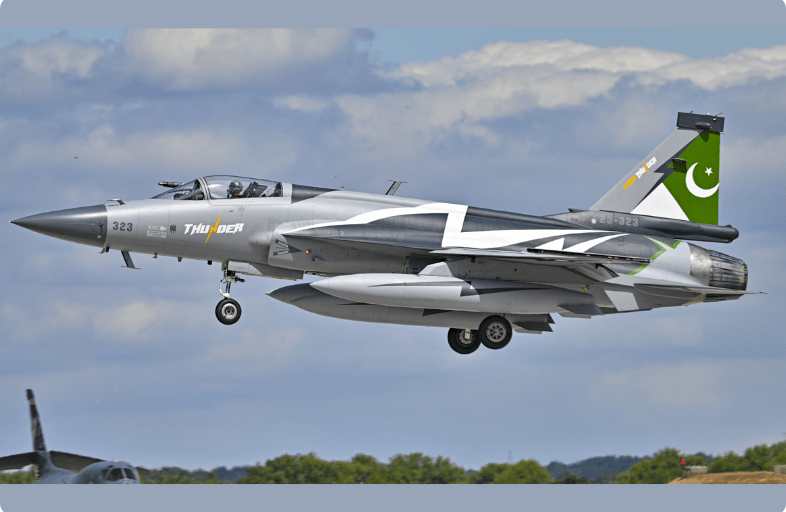
The JF-17 Thunder is a lightweight, multi-role combat aircraft jointly developed by Pakistan and China under the Pakistan Aeronautical Complex (PAC) and Chengdu Aircraft Corporation (CAC) collaboration. Introduced to strengthen the Pakistan Air Force (PAF), the JF-17 serves as a highly versatile and cost-effective fighter jet, capable of performing air-to-air combat, ground attack, and reconnaissance missions.
It is considered one of Pakistan’s most modern fighter jets, providing a strategic advantage in regional defense.
Key Features of JF-17 Thunder
The JF-17 Thunder is equipped with modern avionics and weaponry:
- Multi-role capability: Air-to-air, air-to-ground, and maritime strike
- Avionics: Modern radar systems, electronic warfare capabilities
- Weapon stations: 7 hardpoints for missiles, bombs, and fuel tanks
- Speed & Agility: Maximum speed of Mach 1.6, high maneuverability
- Cockpit: Glass cockpit with digital displays and HUD
These features make it suitable for various combat missions, including air superiority and tactical strike operations.
Specifications of JF-17 Thunder
| Feature | Specification |
| Length | 14.93 m |
| Wingspan | 9.45 m |
| Height | 4.77 m |
| Maximum Speed | Mach 1.6 (~1,975 km/h) |
| Combat Range | 1,352 km |
| Service Ceiling | 55,000 ft |
| Engine | RD-93 afterburning turbofan |
| Crew | 1 (JF-17 Block 1/2/3 variants) |
The latest Block 3 variant features enhanced avionics, AESA radar, and improved weapons integration.
Armament of JF-17 Thunder
The JF-17 carries a wide range of aircraft weapons:
- Air-to-Air Missiles: PL-12, SD-10, Python-5
- Air-to-Ground Missiles: CM-400AKG, HJ-10, guided bombs
- Guns: 23 mm twin-barrel cannon
- Rocket pods and bombs for tactical strikes
The aircraft can engage both aerial and ground targets effectively, making it highly versatile in combat scenarios.
Role in Pakistan Air Force
The JF-17 Thunder plays a critical role in Pakistan’s defense strategy:
- Replaces aging fighter jets like Mirage III and A-5
- Provides a cost-effective solution for multi-role missions
- Enhances air defense and deterrence capabilities
- Participates in joint military exercises and international air shows
It has become a symbol of Pakistan’s indigenous defense technology development.
Variants of JF-17 Thunder
- JF-17 Block 1: Initial production with basic avionics and weaponry
- JF-17 Block 2: Upgraded avionics, improved radar, better weapons integration
- JF-17 Block 3: Advanced AESA radar, electronic warfare system, helmet-mounted display, and enhanced payload capacity
Each variant demonstrates significant technological progress over the previous models.
Why JF-17 Thunder Is Important
- Indigenous production: Boosts Pakistan’s defense industry
- Multi-role fighter: Versatile combat capabilities
- Cost-effective: Affordable compared to Western fighter jets
- Modern technology: Incorporates latest avionics and weapons systems
Strategic advantage: Enhances Pakistan’s air defense and security
Conclusion
The JF-17 Thunder is far more than a fighter jet—it represents Pakistan’s journey toward technological independence, military modernization, and strategic self-reliance. Developed through international collaboration but refined through local expertise, the aircraft has evolved into a symbol of national pride and defense capability. For the Pakistan Air Force, the JF-17 is not just a replacement system; it is a transformational platform that fills multiple operational gaps while remaining financially sustainable.
In an era where modern warfare requires speed, precision, electronic dominance, and adaptability, the JF-17 delivers all four. Its multirole design allows Pakistan to conduct air superiority missions, strike operations, border defense, and maritime engagements without relying excessively on foreign suppliers. With advanced avionics, radar systems, guided missiles, and high maneuverability, it contributes directly to maintaining aerial deterrence in a competitive regional environment.
The introduction of Block-3 pushes Pakistan into a new generation of aerial capability—AESA radar, helmet-mounted displays, enhanced BVR combat, and upgraded electronic warfare now allow pilots to operate with greater situational awareness and extended kill ranges. It proves Pakistan can innovate continuously instead of relying on stagnant imports.
However, the true impact of the JF-17 goes beyond hardware. It strengthens the nation’s defense industry, provides thousands of technical jobs, expands aerospace engineering capacity, and opens doors for global defense exports. The jet has already attracted international buyers, demonstrating that Pakistan can compete in the international arms market with credible, combat-proven technology.
Ultimately, the JF-17 Thunder stands as a testament to vision, perseverance, and strategic planning. It is a message to allies and adversaries alike that Pakistan is capable of defending its airspace with indigenous strength. As production advances and technology improves, the JF-17 is positioned not just to protect Pakistan today—but to secure its skies for decades to come.