
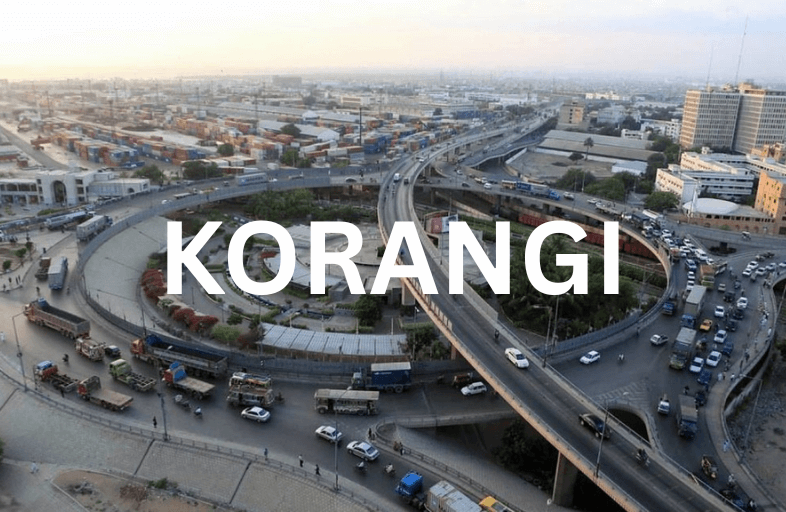
Korangi is one of Karachi’s largest and most dynamic urban areas, known for its mix of residential neighbourhoods, commercial markets, and one of Pakistan’s biggest industrial zones. Located in the eastern part of Karachi, the area is home to millions of people, offering affordable housing, thriving businesses, and a rapidly developing urban landscape.
Whether you’re exploring its industries, food points, educational institutions, or older neighbourhoods, this part of the city represents the true working-class spirit of Karachi.
History of Korangi
The district was established in the late 1950s and early 1960s as part of resettlement plans for migrants who arrived after Partition. Over time, it expanded into several sectors and gradually became a centre of industrial growth in Karachi.
The region later developed into the industrial zone, which now hosts hundreds of factories, warehouses, and multinational companies.
Location & Major Sub-Areas
The locality is divided into several sectors and neighbourhoods, including:
- Sector No. 1, 2, 3, 4, 5, 6
- The Industrial Area
- Zaman Town
- Allahwala Town
- Sector 33, 35, 39
- Darussalam Society
- Baloch Colony (Graceful Chowk)
- Nasir Colony
- UC-based towns after new local government divisions
It connects to major routes such as Shahrah-e-Faisal, Malir Link Road, and Korangi Creek Road, making it easily accessible from DHA, Clifton, and Shah Faisal Colony.
Korangi Industrial Area (KIA) – Economic Backbone
The industrial district here is one of the largest in Pakistan, generating a major portion of Karachi’s economic activity.
Industries in KIA include:
- Textile factories
- Pharmaceutical companies
- Plastic & chemical industries
- Automobile factories
- Food processing units
- LPG plants
- Multinational corporate offices
Thousands of workers commute daily, making it a high-activity zone.
Residential Lifestyle in Korangi
The area is widely known for affordable housing and strong community culture. It includes:
- Low-cost housing colonies
- Middle-class residential blocks
- Gated societies
- Local community centres
Residents enjoy access to shops, mosques, schools, bakeries, and markets within walking distance.
Markets & Shopping in Korangi
This district has some of the busiest commercial centres in Karachi:
- Korangi No. 1 Market – Clothes, groceries, shoes
- Zaman Town Market – Bridal shops, garments, fast food
- Korangi Crossing – Electronics, furniture
- Sector 33 Market – Fashion items, home goods
- Industrial Area Shops – Hardware, tools, mechanical items
You can find everything from street vendors to wholesale shops.
Food & Restaurants
The food scene here is lively and budget-friendly, featuring popular eateries such as:
- Mirza Hotel – Famous for chai & paratha
- Al Madina Restaurant – BBQ & desi food
- BFC (Broast Fried Chicken)
- Waheed Kabab House (Branches)
- Local biryani shops
- Street bun kebabs, gola ganda & shawarma stalls
Food streets in Zaman Town and Korangi No. 4 are especially popular.
Education & Institutions
Korangi has numerous schools, colleges, and technical institutes:
- Ziauddin University (Korangi Campus)
- Govt. Degree College Korangi
- The Educators, Al Suffah Academy, Beacon Light School
- Vocational training centres and technical institutes
Many students also commute to nearby DHA and Shahrah-e-Faisal institutions.
Hospitals & Healthcare
Popular hospitals in Korangi include:
- Indus Hospital (Korangi) – One of Pakistan’s best free hospitals
- Ziauddin Hospital
- Aga Khan Lab & Clinics
- Chiniot General Hospital
These facilities serve residents from all over East Karachi.
Recreation & Parks
Korangi has several parks and community spaces, such as:
- Sector 33 Park
- Korangi Zoo (small-scale)
- Family parks & playgrounds
- Korangi Creek areas near DHA Phase 7 & 8
While not luxury-level, they offer fresh air and open spaces for families.
Transportation & Connectivity
Korangi’s roads connect it to:
- DHA & Clifton
- Landhi
- Shah Faisal Colony
- Malir Halt
- Shahrah-e-Faisal
Public transport, ride-hailing services, rickshaws, and buses are widely available.
Why This Locality Matters
This part of Karachi plays a crucial role in:
- Karachi’s industrial economy
- Affordable living
- Job creation
- Urban connectivity
- Small businesses & markets
It represents the hardworking backbone of the city.
Conclusion
This locality is a vibrant mix of industrial strength, residential neighbourhoods, active markets, diverse communities, and affordable food culture. Despite crowded streets and fast-paced routines, it continues to grow and remains an essential part of Karachi’s economic and social fabric.
What makes this area unique is its balance between affordability and opportunity. For working-class and middle-income families, it offers accessible housing, proximity to employment, and strong neighbourhood networks. Daily life revolves around local markets, mosques, schools, and small businesses, creating a self-sustaining ecosystem where most needs are met within short distances. This reduces dependence on distant city centres and strengthens long-standing community bonds.
From an economic perspective, its importance cannot be overstated. The industrial zone continues to support thousands of small and large businesses, employ a massive workforce, and contribute significantly to exports and national revenue. Many households across Karachi depend directly or indirectly on the economic activity generated here.
In essence, this locality represents the working heart of Karachi. It is where industries function, workers live, markets operate, and communities persist despite the pressures of urban expansion. While it may not dominate tourist brochures or luxury real estate discussions, its contribution to the city’s survival and growth is undeniable.
As Karachi continues to expand and evolve, this area will remain central to its progress. Understanding it is not just about learning a neighbourhood’s name. It is about understanding how the city sustains itself today and prepares for the future.